Royalty-Free Does Not Mean Copyright-Free: Understanding What You Are Actually Buying
The difference between permission to use an image and the right to sell it is one that every artist, photographer and digital creator should understand.
There is a persistent misunderstanding within the creative world surrounding the term *royalty-free*. It is a phrase that sounds wonderfully unrestricted, suggesting that once an image has been purchased or downloaded, the buyer is free to do whatever they wish with it.
Unfortunately, that assumption can lead to copyright infringement, disputes over ownership and, in some circumstances, serious legal conequences.
Royalty-free does not mean copyright-free. It does not mean that an image belongs to whoever downloads it, and it certainly does not mean that the purchaser has acquired unrestricted commercial rights.
What it means is considerably more specific, and understanding that distinction is essential for anyone working with photography, traditional art, digital imagery, graphic design or print-on-demand products.
What Is a Royalty-Free Licence?
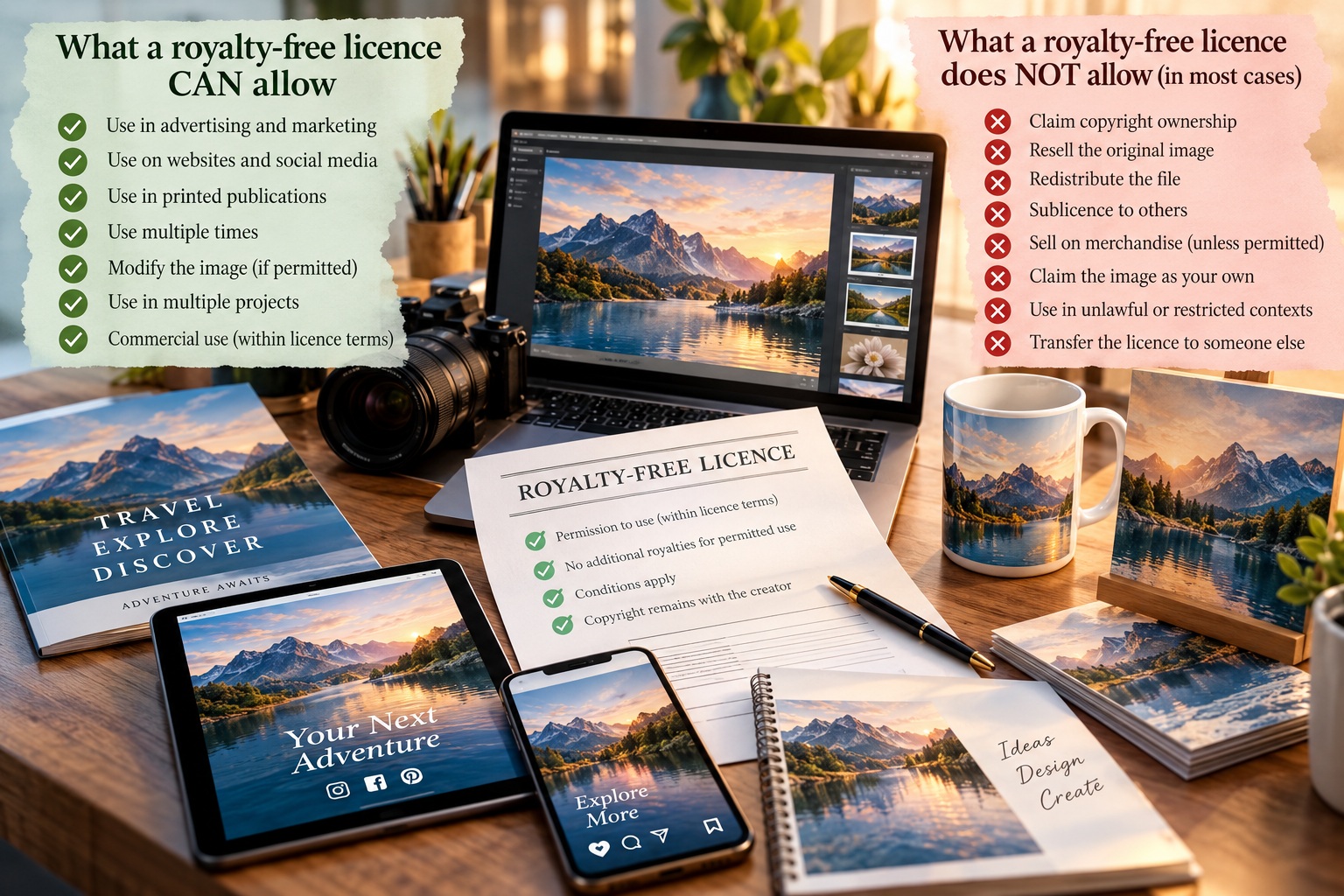
A royalty-free licence is an agreement that grants someone permission to use a copyrighted work without having to pay a separate royalty every time that work is used, provided the use falls within the terms of the licence.
The licence might be purchased for a single fee, included within a subscription or even provided free of charge. The important point is that the licence establishes what the recipient is permitted to do with the work.
For example, a business might purchase a royalty-free photograph to use in an advertising campaign. Depending on the licence, that business may be able to use the same photograph on its website, in brochures, on social media and in other promotional materials without paying the photographer again for each permitted use.
However, the photographer generally retains copyright. The business has purchased permission to use the photograph, not ownership of the photograph itself.
This is the fundamental distinction that is so frequently overlooked.
Purchasing a Licence Is Not Purchasing Copyright
Copyright protects original creative works, including photographs, paintings, illustrations, graphic designs and many forms of digital artwork.
In the United Kingdom, copyright generally arises automatically when a qualifying original work is created. There is no requirement to register it for protection to exist.
When an artist licenses an image, they are granting another person or organisation certain permissions. Unless copyright is formally transferred, the copyright remains with its existing owner.
A royalty-free licence is therefore not a certificate of ownership.
The purchaser cannot simply announce that the image is now theirs, claim to have created it or assume that they have acquired the right to distribute it however they please.
Even when a licence permits extensive commercial use, the licence holder remains bound by its conditions.
Those conditions matter far more than the appealing words *royalty-free*.
What Can You Actually Do With a Royalty-Free Image?
The answer depends entirely on the licence.
Many royalty-free licences permit images to be used in advertising, websites, blogs, newsletters, magazines, books, presentations and social media content.
Some permit alterations, allowing the purchaser to crop the image, change its colours, add text or incorporate it into a larger design.
Others allow the same image to be used repeatedly across several projects without requiring additional royalty payments.
However, these permissions are not universal.
One licence might permit unlimited digital advertising but restrict printed copies. Another might permit editorial use but prohibit commercial advertising. A third might allow extensive commercial reproduction while specifically excluding merchandise intended for resale.
Even the meaning of *unlimited use* requires care. Unlimited use within a licence does not mean unlimited rights outside that licence.
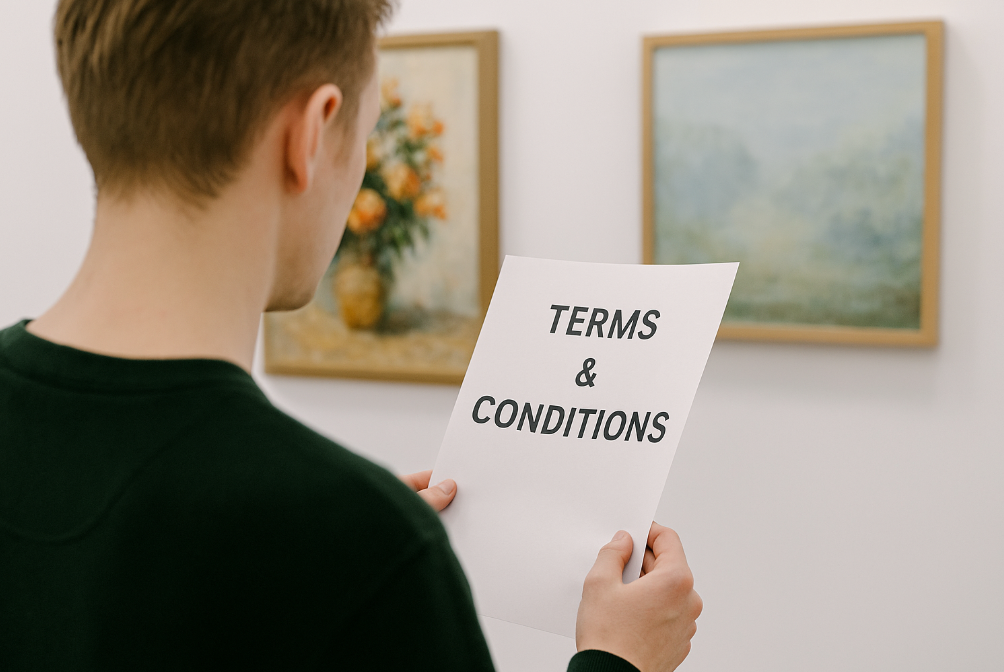
The only reliable way to establish what is permitted is to read the actual agreement.
The Problem With Selling Royalty-Free Images as Artwork
One of the most significant areas of confusion concerns print-on-demand websites and online art marketplaces.
Consider someone who purchases a royalty-free photograph of a beautiful landscape.
The licence might permit that person to use the photograph in a travel brochure, on a business website or as part of a promotional campaign.
They may then decide that the photograph would look wonderful as a framed print. They upload it to an online marketplace and offer it for sale as wall art, canvas prints, greeting cards and other products.
At this point, a crucial question arises.
**Does the licence actually permit the image to be reproduced and sold as merchandise?**
Many standard royalty-free licences do not.
There is an important difference between using an image to promote a product and making the licensed image itself the principal attraction of the product being sold.
For example, using a licensed photograph in an advertisement for a coffee shop is very different from printing that photograph on hundreds of mugs and selling them to customers.
In the first example, the image supports the business’s advertising.
In the second, the image itself may be the reason someone purchases the product.
Some licensing companies recognise this distinction by offering extended licences that permit certain merchandise and resale uses.
Others impose additional restrictions, including limits on production quantities or requirements concerning how the image is incorporated into the finished product.
Consequently, it would be equally incorrect to claim that royalty-free images can never be used on merchandise.
Some licences expressly allow it.
What matters is whether the particular licence grants the necessary rights.
For artists using print-on-demand platforms, this distinction is especially important. A licence allowing commercial use does not automatically establish that the image may be uploaded and offered for sale across an entire product catalogue.
Does Altering an Image Make It Yours?
Another common misunderstanding is the belief that changing an image sufficiently makes it a new, independently owned work.
Someone might purchase a royalty-free photograph, change its colours, remove the background, apply digital painting effects, add textures or combine it with other imagery.
They may then argue that the finished result is entirely their own because they have modified the original.
Unfortunately, copyright does not work quite so conveniently.
A licence may permit alterations, and sufficiently original additions may attract their own copyright protection. However, those additions do not automatically remove the rights attached to the underlying image.
If the original photograph remains protected by copyright, the licence holder must still comply with the permissions granted for that photograph.
Adding filters, applying artificial intelligence tools or digitally manipulating an image does not magically erase the original creator’s rights.
This does not mean that every artwork incorporating licensed material is unlawful. Collage, photomontage, digital composition and mixed-media art can all legitimately incorporate licensed resources.
The issue is whether the artist has permission to use those resources in the particular way intended.
There is a considerable difference between creating something new with appropriately licensed materials and assuming that any amount of alteration gives unrestricted rights to someone else’s work.
Can You Give the Image to Someone Else?
Generally, a royalty-free licence does not automatically permit the purchaser to distribute the original file to other people.
If a designer purchases a licensed image for a client’s website, for example, the licence may allow the designer to incorporate the image into the finished website.
That does not necessarily mean the designer can give the client an unrestricted copy of the original image file to use in unrelated projects.
Similarly, purchasing a licence does not normally give someone permission to upload the image to another stock library, distribute it as a downloadable resource or sell licences to third parties.
Those activities may require separate permissions.
A licence is not an invitation to become a licensing company yourself.
What About Free Images?
The situation becomes even more confusing when images are offered for free.
Many people assume that if an image can be downloaded without payment, it must be free of copyright restrictions.
That is not necessarily true.
An image might be available under a free royalty-free licence, a Creative Commons licence or another agreement containing specific conditions.
Some licences require attribution. Others prohibit commercial use or restrict modifications. Certain free image libraries permit broad commercial use while prohibiting the resale of substantially unaltered images as standalone products.
There are also genuinely public domain works, which are different from works distributed under royalty-free licences.
A public domain work is generally no longer protected by copyright, or was never protected in the relevant jurisdiction. However, other legal considerations may still apply.
The absence of a price tag tells us very little about the rights attached to an image.
**Free to download and free to do anything with are two entirely different things.**
The Importance of Keeping Licensing Records
For anyone creating commercial work with licensed imagery, keeping accurate records should be a normal part of the creative process.
It is sensible to retain the original licence agreement, purchase receipt or download confirmation, the name of the licensing provider, the date the image was obtained and the relevant image identification details.
This becomes particularly important when licences change over time.
A website might update its terms, remove an image from its catalogue or alter the permissions available to future purchasers.
Having a copy of the licence that applied when the image was acquired can help establish what permissions were originally granted, although the agreement itself determines how those permissions operate.
It is also worth remembering that an image appearing on a reputable licensing website does not necessarily resolve every possible rights issue. Photographs featuring identifiable people, private property, protected designs or trademarks may raise additional questions concerning model releases, property permissions and commercial usage.
Copyright is only one part of the wider legal picture.
The Responsibility Lies With the Person Using the Image
When someone uploads an image to an art marketplace, publishes it commercially or incorporates it into merchandise, they are responsible for ensuring that they possess the necessary rights.
Simply stating that the image was purchased from a stock library is not sufficient evidence that every intended use is authorised.
Nor does the phrase *royalty-free* settle the question.
A marketplace may have its own terms requiring contributors to hold particular rights to everything they upload. Those requirements can be more restrictive than the permissions granted by an external stock image licence.
A licence that permits commercial reproduction in one context may not satisfy the requirements of another platform.
This is why artists should never assume that a stock image licence automatically permits resale through websites such as Fine Art America, Pixels or other print-on-demand services.
The relevant questions are straightforward.
Does the licence permit commercial reproduction? Does it specifically allow merchandise intended for resale? Does it permit the image to provide the primary value of the product? Does it authorise the necessary use through a third-party platform? Are there restrictions on quantities, alterations or distribution?
If the answers cannot be established from the licence, the intended use should not simply be assumed to be permitted.
Respecting Copyright Protects Everyone
It is tempting to view copyright restrictions as an inconvenience, particularly when an image is readily available online and obtaining a licence requires little more than clicking a button.
However, copyright is one of the mechanisms through which artists, photographers and other creators retain control over the commercial exploitation of their work.
A photographer may spend years developing their skills, invest considerable money in equipment and travel, and dedicate hours to capturing and processing a single image.
An illustrator may spend days creating a design.
A painter may devote weeks to producing an original composition.
When those creators choose to license their work, they are making specific permissions available to others. They are not necessarily surrendering control over everything they have created.
Respecting those permissions is not simply about avoiding legal difficulties. It is about recognising that creative work has value and that its creator has rights.
Equally, legitimate licensing is an important and useful part of the creative industries. Artists and designers should be able to incorporate appropriately licensed materials into their work without being treated as though every use of stock imagery is inherently improper.
The distinction lies in understanding the licence and complying with its terms.
Final Thoughts: Read the Licence, Not Just the Label
Royalty-free licensing provides valuable flexibility for businesses, designers, publishers and artists. It allows creative material to be used in numerous ways without requiring a separate royalty payment for every permitted use.
However, that flexibility is not the same as unrestricted ownership.
A royalty-free licence does not automatically transfer copyright, permit resale, authorise merchandise production, allow redistribution or give someone the right to claim another creator’s work as their own.
Some licences grant extensive permissions, including commercial merchandise rights. Others are considerably narrower.
The words *royalty-free* alone cannot tell you which permissions you have acquired.
Before incorporating someone else’s work into a commercial project, particularly one involving products for resale, take the time to establish exactly what the licence permits.
And if someone claims that purchasing a royalty-free image gives them the right to sell it as their own artwork, there is one very reasonable question to ask:
**Can you show me where the licence gives you permission to do that?**
Because purchasing permission to use someone else’s creativity is not the same thing as purchasing the creativity itself.
*© Abbie Shores | Art, Copyright and the Creative Industries*