
Google, Social Media, and the Myth of the “Single Source” Sale
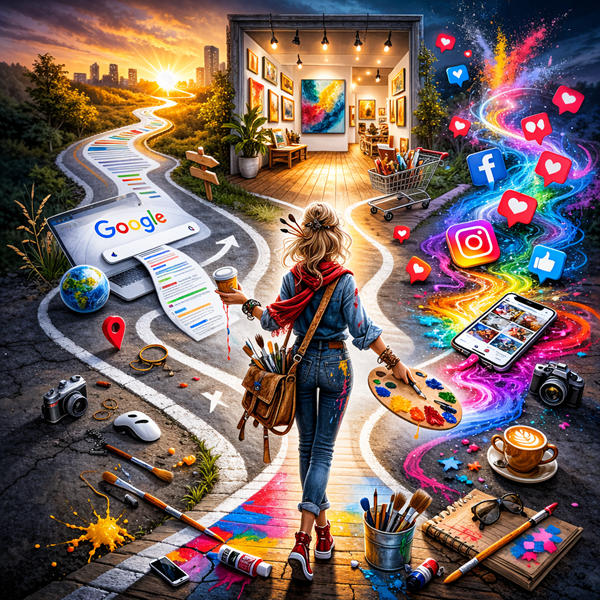
There is a persistent argument in the art world about where sales truly come from.
Is it social media?
Is it Google?
Is it internal marketplace search?
The debate often becomes binary. As though one must cancel the other but it does not work like that.
What most artists miss is that discovery and purchase are not the same psychological event. They are separate stages in a sequential journey and understanding that distinction changes everything.
The Psychology of Discovery
Social media feeds the impulse brain.
You are not looking for art. You are scrolling. A piece appears. It sparks something emotional. You pause. You feel. That is visual interruption marketing. It is powerful. It introduces new artists. It creates awareness.
But awareness is not intent.
Search engines operate differently. When someone types “large blue abstract canvas for modern living room”, they are not browsing. They are solving a problem. They have moved from inspiration to intention. Intent converts more reliably than impulse.
This is not opinion. It is behavioural economics.
Acquisition Versus Amplification
One of the most confused areas in marketing discussions is the difference between acquisition and amplification.
Acquisition is how the buyer arrives.
Amplification is what increases visibility once they are inside the ecosystem.
Google often functions as acquisition. It captures existing demand and directs it to high-authority platforms.
Internal marketplace search and ranking systems often function as amplification. They influence which works are surfaced once the buyer is already browsing.
These are not competing forces. They are sequential.
Google is the doorway.
Internal search is the shop floor layout.
Without the doorway, no one enters.
Without the layout, no one finds what they want.
The Danger of Keyword Obsession
A natural reaction to this discussion is: “Tell us what buyers are searching for so we can create around that.”
On the surface, that sounds strategic, however, in practice, it can become destructive.
When artists create primarily around popular search phrases, markets saturate quickly. Work becomes generic. Identity dissolves into trend chasing.
Search demand matters. Of course it does.
But long-term sustainability in art comes from recognisable voice combined with intelligent visibility, not from manufacturing content around search data.
There is a difference between optimising your presentation and reverse-engineering your creativity.
One strengthens your brand.
The other erodes it.
Social Media Is Not Useless
None of this diminishes social media.
Social platforms are extraordinarily effective at:
• Creating emotional connection
• Building familiarity
• Humanising the artist
• Generating repeat buyers
• Encouraging impulse purchases
But the conversion rate from passive scrolling to purchase is naturally lower than from active search intent.
Both matter. They simply serve different psychological functions.
Why This Distinction Matters
Artists often argue as though there must be one “true” driver of sales.
The more sophisticated view is this:
Search engines capture demand.
Social media stimulates awareness.
Internal search influences exploration.
Brand identity drives repeat buying.
They are layers of a funnel, not rivals in a contest.
When we blur acquisition and conversion into one undefined “source of sales”, we miss the mechanics that actually govern behaviour.
And understanding behaviour is the only real marketing advantage.
The Quiet Truth
The art world loves to argue about algorithms. What it rarely discusses is buyer psychology.
People buy art for emotional reasons.
They search for it for practical ones.
They explore options for reassurance.
They return for identity.
If you understand those stages, you stop chasing every new headline about “what Google prefers this week” or “what social media is boosting today”. Instead you focus on building something consistent enough to be found, strong enough to be remembered, and distinctive enough to be chosen.
That is literacy, not a trick






[…] Read the full post on the member blog → […]