
Imposter Syndrome in Artists and Authors: The Hidden Toll of Self-Doubt
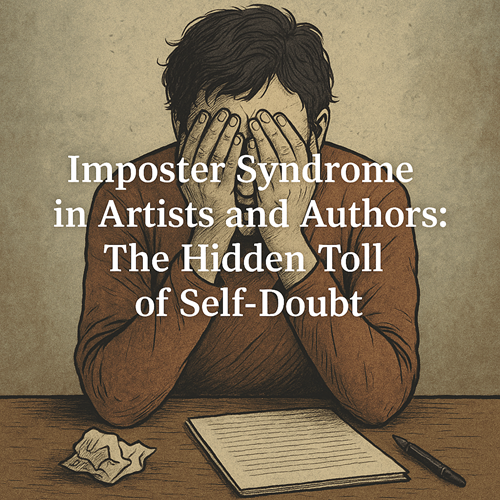

Creative expression is often romanticised as a joyful outpouring of inspiration. Yet for many artists and authors, the reality is far more complex. Beneath the surface of even the most accomplished work lies a persistent shadow — imposter syndrome — a deeply unsettling belief that one’s talents are fraudulent, that success is undeserved, and that sooner or later, the truth will be discovered.
This psychological state is not rare among creatives. In fact, it may be alarmingly common. The internal voice whispering, “You’re not good enough,” tends to grow louder not during the act of creation, but after the work is complete, when vulnerability peaks and self-criticism takes root. What should be a moment of pride can instead spiral into a debilitating depression.
The Urge to Destroy One’s Own Work
Many creatives report an overwhelming compulsion to delete, discard, or even physically destroy their finished work. It may happen minutes after completion, or creep in days, weeks, or months later. The thought “this is rubbish”, or worse, “I am a waste of effort”, can become all-consuming.
And yet, in hindsight, many regret these decisions. A story deleted. A painting painted over. A sketchbook thrown away. The regret may come the next day, or years later — but it almost always does.
Why Does This Happen?
Several factors contribute to these painful emotions:
Perfectionism – The desire to meet impossibly high standards can make anything less than flawless feel unworthy of sharing.
Vulnerability of expression – Creative work exposes the soul, and the instinct to retreat is powerful.
Comparison culture – The endless scroll of others’ polished work can make even the talented feel inadequate.
The silence that follows – A lack of response after sharing can feel like failure, even when it’s not.
Past invalidation – Those who’ve faced ridicule or dismissal before may subconsciously expect the same response again.
What Can Help?
While imposter syndrome may never vanish entirely, its grip can be loosened:
Create a ‘waiting’ period – Never delete or discard immediately. Make a personal rule: wait 48 hours. Revisit it with fresh eyes.
Keep a creative journal – Log your thoughts, process, and progress. It becomes a powerful reminder of how far you’ve come.
Find safe feedback spaces – Share work with supportive, understanding peers rather than a faceless audience.
Be kind to yourself – Speak to yourself as you would to a fellow creative. Harshness does not nurture growth.
Detach identity from output – One piece of work — good or bad — does not define your worth.
Accept imperfection – Not every piece needs to be your best. Sometimes, simply finishing something is
A Gentle Reminder
To create is to be vulnerable. And in a world that often prizes perfection over authenticity, that vulnerability can sting. But your feelings of doubt are not a sign of failure — they are often a mark of how deeply you care.
So if you find yourself hovering over the delete button, take a breath. Step back. Give tomorrow-you a chance to look again. The work you’re doubting today might be the one you’ll miss tomorrow.
Your creativity has value. And so do you.
You are a published author, not a wannabe!
I know you’re right…. It’s hard sometimes.
Arrrggghhh!! ::shakes a fist in the air:: Imposter syndrome BITES.
Hard to imagine that you sometimes feel it, too, Abbie. From my perspective you’re the real deal. But…I get how we can all be vulnerable.
It grips me every time I crawl out of my cozy hiding place and try to “do art to sell.” No training, no patience, no idea what I’m doing most of the time. But I do occasionally make stuff that pleases my eye. I was never meant to be an artist! I was supposed to be a scientist. Then I was supposed to teach music. Then I got a job, stayed there 24 years, Then I was supposed to be a lawyer! All three of those professions would’ve made sense & been relatively easy for me to find some success in. Artist? Nope. The only clue to any art-link was how I drew cartoons to teach people or to explain difficult concepts. ::sigh::
The only thing I don’t do is destroy old work. I keep everything but no one ever sees it. I promise myself that I’ll make collages out of it. Then…nothing. And the piles grow in closets. Death by darkness?
Here’s something: I’ve wasted soooo much money on domains with the words “artist” or “art” in them bec even tho they sounded sensible at the time I couldn’t bring myself to USE them. Art? Artist?? ME??? False advertising! Drop that name before someone finds out the truth and reports me to the Art Police!!
Phooey.
What rankles is that supportive communities are very difficult to find. We’re all out here trying to sell! We’re competing! Not the same stuff, not in the same ways – but still competing. It’s a weird mix of motives.
OK, enough whining. I’m so glad you posted this! I just searched for it on your site, hoping, & hooray! It’s here & it’s very wise.
Thank you for the opportunity to let that out. I feel better.
You ROCK.
🙂
Robin, this made me laugh, wince, and nod all at once.
“The Art Police” may be my new favourite imaginary authority, and I am fairly certain they have no jurisdiction here.
I completely understand what you mean, though. That feeling of “surely someone is going to realise I am making this up as I go along” is horribly familiar. I think a lot of creative people live with one foot in confidence and the other in a trapdoor.
And honestly? Making work that pleases your own eye counts. That is the beginning, middle, and sometimes the whole point.
The scientist, the music teacher, the long career, the almost-lawyer…. none of that disqualifies you from being an artist. It probably feeds the art in ways you do not even notice. Cartoons used to explain difficult ideas? That absolutely sounds like an art-link to me.
As for supportive communities, yes. They can be hard to find, especially when selling gets tangled up with creating. But I do believe there is room for us to cheer each other on without it taking anything away from anyone else.
Thank you so much for writing this. I am very glad you let it out here.
And please do not let those closet piles die in darkness forever. Even if they only become one tiny collage, let one escape.