Why Authorities Have Always Feared Books
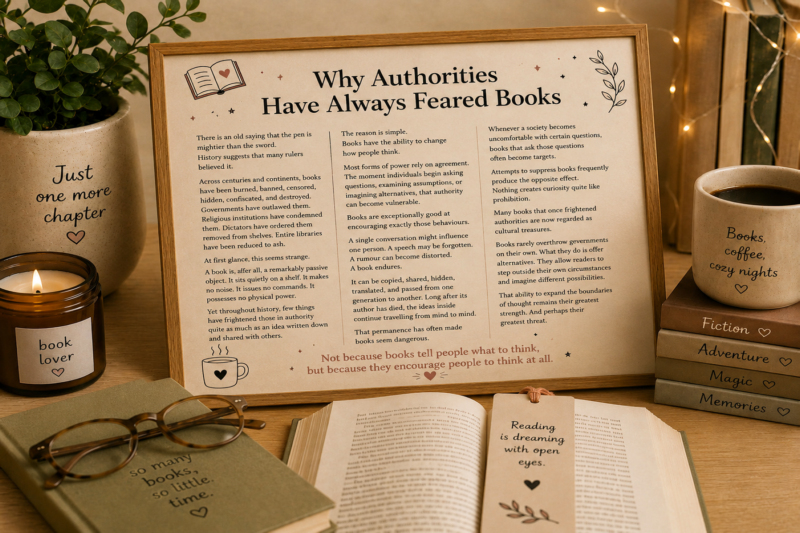
There is an old saying that the pen is mightier than the sword. History suggests that many rulers believed it.
Across centuries and continents, books have been burned, banned, censored, hidden, confiscated, and destroyed. Governments have outlawed them. Religious institutions have condemned them. Dictators have ordered them removed from shelves. Entire libraries have been reduced to ash.
At first glance, this seems strange. A book is, after all, a remarkably passive object. It sits quietly on a shelf. It makes no noise. It issues no commands. It possesses no physical power. Yet throughout history, few things have frightened those in authority quite as much as an idea written down and shared with others.
The reason is simple.
Books have the ability to change how people think.
Most forms of power rely on agreement. Whether a king, government, church, corporation, or social system, authority functions most effectively when people accept that things are as they should be. The moment individuals begin asking questions, examining assumptions, or imagining alternatives, that authority can become vulnerable.
Books are exceptionally good at encouraging exactly those behaviours.
A single conversation might influence one person. A speech may be forgotten. A rumour can become distorted. A book endures.
It can be copied, shared, hidden, translated, and passed from one generation to another. Long after its author has died, the ideas inside continue travelling from mind to mind.
That permanence has often made books seem dangerous.
Throughout history, authorities have feared many different kinds of writing. Political books have challenged governments. Scientific books have challenged accepted beliefs. Religious texts have challenged established institutions. Novels have challenged social expectations.
Sometimes the fear seems understandable.
Revolutionary ideas can genuinely reshape societies. Political movements have often been fuelled by books. Philosophies that changed the world frequently began as words on a page.
More often, however, the fear reveals something else…..A lack of confidence.
Strong ideas rarely need protection from competing ideas. They survive scrutiny. Weak ideas, by contrast, often depend upon preventing people from encountering alternatives. That is why censorship so often targets information rather than violence.
The authorities are not afraid of paper, instead they are afraid of possibility.
Some of history’s most famous books were considered deeply threatening when they first appeared. Works that are now studied in schools and universities once generated outrage, panic, and official attempts at suppression.
What seems ordinary today often appeared revolutionary in its own time.
A book advocating religious tolerance could be dangerous. A novel questioning class divisions could be dangerous. A scientific text challenging accepted understanding could be dangerous. Even stories that simply portrayed unfamiliar people sympathetically have sometimes been viewed as threats. The pattern repeats throughout history. Whenever a society becomes uncomfortable with certain questions, books that ask those questions often become targets.
Ironically, attempts to suppress books frequently produce the opposite effect. Nothing creates curiosity quite like prohibition. A book quietly sitting on a shelf may attract little attention. Label it dangerous, and people suddenly become desperate to discover what it contains.
History is littered with examples of books that gained fame largely because someone tried to ban them.
There is a deeper irony as well.
Many books that once frightened authorities are now regarded as cultural treasures. They are displayed in museums, taught in classrooms, and celebrated as milestones of literature or human thought.
The dangerous ideas often became accepted ideas. The controversial questions became ordinary questions. The feared books became classics.
Perhaps that reveals something important about the relationship between power and knowledge.
Books rarely overthrow governments on their own. They do not launch revolutions single-handedly. They do not force people to change their beliefs. What they do is offer alternatives. They allow readers to step outside their own circumstances and imagine different possibilities. Different societies. Different futures. Different ways of understanding the world. That ability to expand the boundaries of thought remains their greatest strength.
And perhaps their greatest threat.
Not because books tell people what to think but because they encourage people to think at all.
That is why authorities have feared books for centuries and why books continue to matter. 📚🔥



[…] Read the full post on the member blog → […]