
The Economics of Exposure
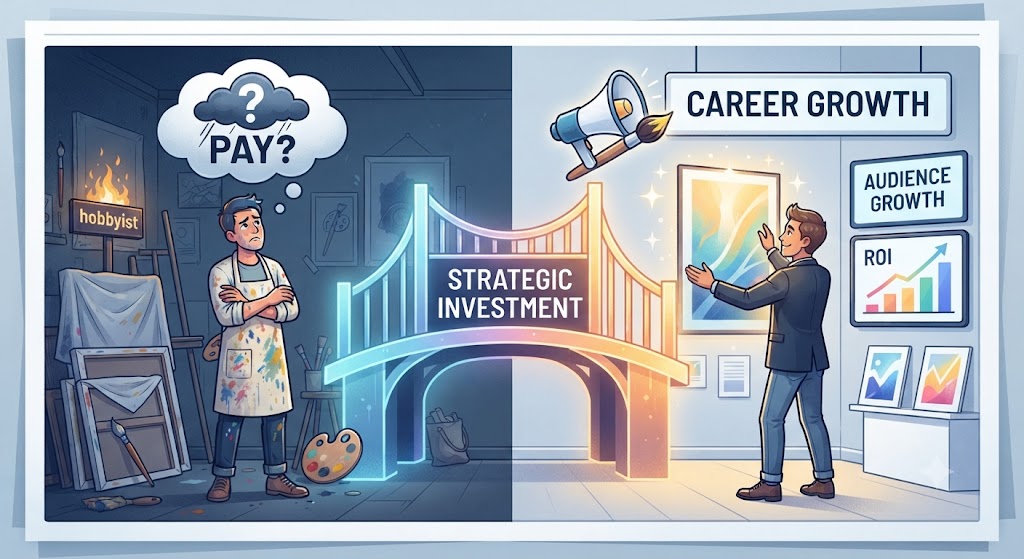
For many artists, the act of creation is a deeply personal, often spiritual pursuit. When the time comes to shift from the studio to the storefront, from creating art to marketing it, a natural friction occurs. This friction often manifests as a resentment toward advertising costs, particularly when third parties ask for payment to promote an artist’s work.
However, viewing marketing solely as a “necessary evil” or an imposition is a misunderstanding of how the creative economy functions in 2026. To be a sustainable artist, one must bridge the gap between passion and professional reach.
Why Marketing is Non-Negotiable
In an attention-saturated digital landscape, talent alone is rarely enough to find an audience. Marketing is not merely about “selling out”; it is about accessibility.
Discovery: Your work cannot be appreciated if it is not seen. Marketing is the bridge that connects your creative output to the people who are looking for exactly what you make.
Sustainability: Art requires resources—time, materials, and space. Marketing transforms admiration into support, providing the financial sustainability necessary to continue creating.
Professional Identity: Consistent, intentional marketing signals that you are a serious professional. It builds trust with potential collectors, curators, and partners, moving your work from “hobbyist” status to a legitimate career.
The Budget Reality: How Much is “Right”?
There is no universal dollar amount, but there is a universal principle: Marketing should be a strategic investment, not an emotional expense.
Setting a budget should be tied to your goals and your current stage of growth. A common professional guideline is to allocate 5–10% of your total revenue toward marketing. However, for emerging artists, that percentage may need to be higher to gain traction.
A Framework for Spending
Validate First: Before spending significant money, test your work organically. If a piece or project does not resonate with a small, free audience, paid ads will likely not fix the problem; they will only amplify the lack of engagement.
Start Small: Test with small amounts ($50–$100) on highly targeted platforms. Monitor what works. Are people clicking? Are they engaging?
Scale by Efficiency: Only increase your spend when you have “proof of concept.” If an ad campaign brings in new followers or sales at a cost that is lower than the value they provide, that is where you double down.
Know Your Ceiling: If your cost per result increases as you spend more, you have reached the point of diminishing returns. Stop there.
The “Pay-to-Play” Controversy: Why It’s Not Always Unjust
Artists often feel frustrated when galleries, influencers, or curators ask for money to promote their work. This is often viewed as a “cash grab” or a betrayal of artistic integrity. Yet, it is often a matter of operational reality.
Resources Are Finite: Curators, magazines, and platforms incur costs to operate….staffing, website hosting, email management, and digital ad spend. When they promote you, they are leveraging their own time, audience, and infrastructure. Expecting that for free is effectively asking them to subsidise your business with their own.
The Difference Between “Pay-to-Play” and “Paid Placement”: * Scams: Avoid entities that guarantee “massive results” or “instant fame” for a flat fee. These are often fraudulent and will damage your reputation or algorithm performance.
Legitimate Services: A professional curator or partner asking for a fee to cover the actual cost of marketing (e.g., a newsletter blast, a sponsored post, or a dedicated exhibition opening) is not necessarily unethical; it is a business transaction.
The Investment Perspective: If a platform has an established, high-quality audience that matches your target demographic, paying them for exposure is no different than purchasing a billboard or a digital ad. You are paying for access to an audience they spent years cultivating.
The frustration surrounding marketing costs is understandable, but it is often misdirected. The goal is not to eliminate the cost of promotion, but to eliminate the wasteful cost. By treating marketing as a calculated investment rather than a hurdle, artists can move from a defensive stance of “why should I have to pay?” to an offensive strategy of “how can I best leverage this channel to grow my career?”
Do you have a specific project or budget range you are currently trying to plan for, or are you looking for more guidance on how to distinguish between legitimate marketing opportunities and predatory ones? Comment Below….



[…] Read the full post on the member blog → […]